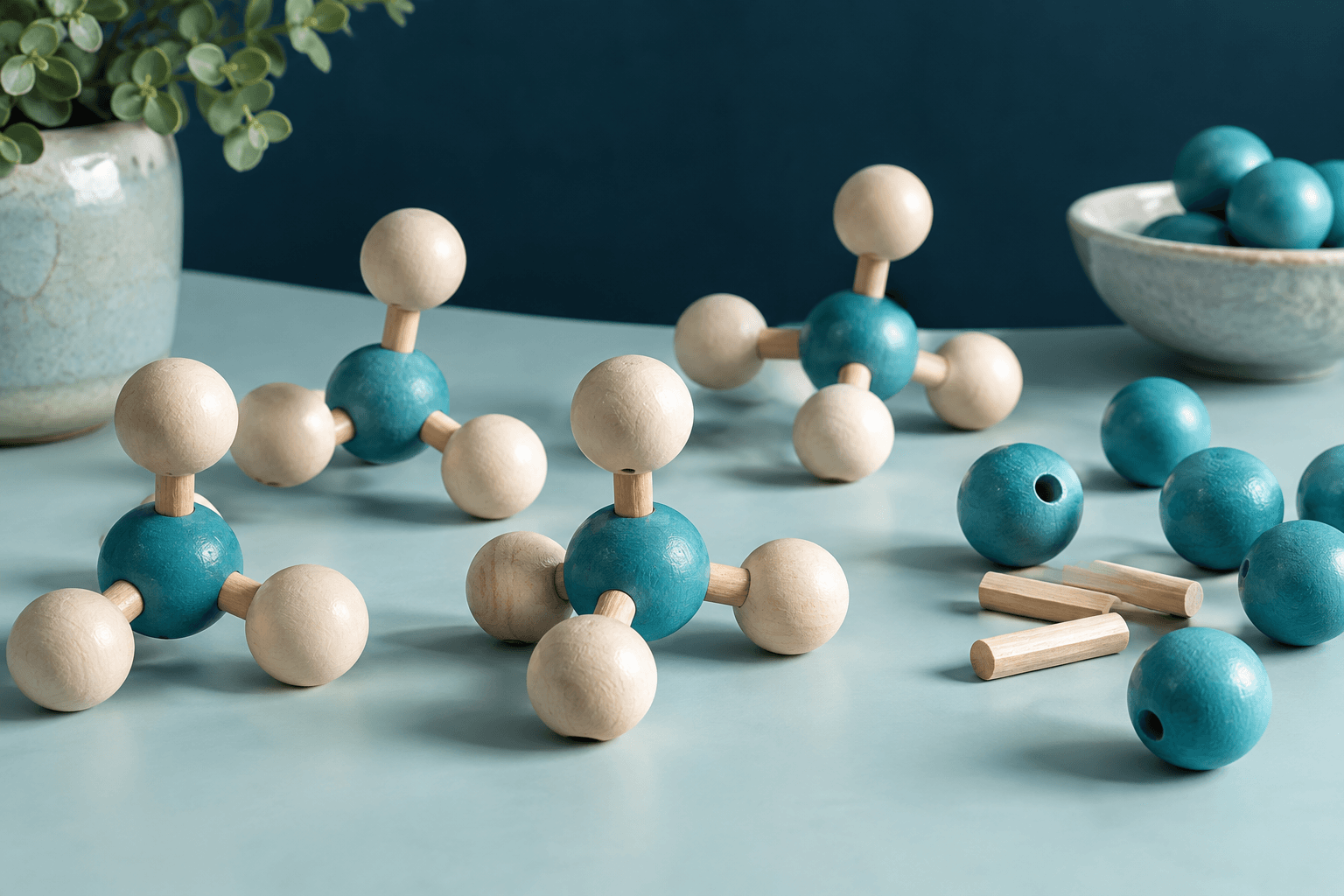
One reactant has the smaller mass, so it must run out first. That shortcut is tempting—and unreliable. Chemical equations compare amounts in a specified mole ratio, not whichever mass happens to look smaller.
The cleanest approach is to ask the same question of every reactant: how much of the chosen product could this amount make if the other reactants were available? The smallest supported product amount identifies the limiting reactant under the problem's assumptions. Then use that reactant for the theoretical yield.
Start with a balanced equation
A balanced equation supplies the stoichiometric relationships between reactants and products. Convert given masses to moles before applying those ratios. Limiting-reactant analysis compares the available quantities with the required proportions; theoretical yield assumes the specified reaction proceeds as represented. OpenStax, Chemistry 2e, Reaction Yields
Keep three lines separate: given quantity, amount in moles, and possible product. Writing the units along the calculation makes it easier to see where a mass-to-mole conversion ends and a stoichiometric conversion begins.
If the equation is unbalanced, pause. Every later ratio will depend on that first step. A neat answer at the end cannot repair an incorrect coefficient at the beginning.
Worked example with amounts already in moles
Use this original paper exercise:
N₂ + 3 H₂ → 2 NH₃
Suppose you have 2 mol N₂ and 3 mol H₂. Ignore practical industrial conditions; this is a stoichiometric accounting problem with complete consumption of the limiting reactant assumed.
From nitrogen, the possible ammonia amount is 2 mol N₂ × 2 mol NH₃ per mol N₂ = 4 mol NH₃. From hydrogen, it is 3 mol H₂ × 2 mol NH₃ per 3 mol H₂ = 2 mol NH₃.
Hydrogen supports the smaller amount, so it is limiting. The theoretical amount of ammonia is 2 mol, not the average of the two possibilities and not their sum.
Now check the excess reactant. Consuming 3 mol H₂ requires 1 mol N₂. You started with 2 mol N₂, so 1 mol N₂ remains in this idealised calculation. The leftover is a useful consistency check.
The ratio check says the same thing
You can also divide each available amount by its reactant coefficient. Nitrogen gives 2/1 = 2 reaction units; hydrogen gives 3/3 = 1 reaction unit. Hydrogen supports fewer complete stoichiometric units.
This method is compact, but write what the division means. Otherwise it becomes another formula you can accidentally apply to grams. The coefficients relate amounts in moles, so the input must be in the appropriate unit.
The product-comparison and coefficient-division methods are not competing chemistry rules. They organise the same proportional reasoning in two different ways. Choose one that you can explain and use the other to check a difficult problem.
If the two methods disagree, keep the original working visible. Check that you converted every reactant to moles, used its own coefficient and compared the same product in both calculations. Replacing the answer without locating the disagreement makes the next problem just as difficult.
Worked example starting from mass
Consider a second original exercise:
2 Mg + O₂ → 2 MgO
Use approximate molar masses of 24.3 g/mol for Mg and 32.0 g/mol for O₂, as specified for this exercise. You have 4.86 g Mg and 1.60 g O₂.
The amounts are 4.86/24.3 = 0.200 mol Mg and 1.60/32.0 = 0.0500 mol O₂. Magnesium could form 0.200 mol MgO. Oxygen could form twice its amount, or 0.100 mol MgO. Oxygen is therefore limiting.
Using an exercise molar mass of 40.3 g/mol for MgO, the theoretical product mass is 0.100 × 40.3 = 4.03 g. The smaller starting mass happened to be limiting here, but that coincidence is not the method. The balanced ratio and mole calculations establish the result.
Mass-to-mole conversion uses molar mass as the connection between the two quantities. OpenStax, Formula Mass and the Mole Concept
Keep actual yield separate
If the magnesium exercise produced 3.22 g of isolated product, the percentage yield would be 3.22/4.03 × 100 ≈ 79.9%. This compares actual with theoretical yield; it does not change which reactant was limiting in the starting calculation. OpenStax, Reaction Yields
Do not use the actual yield to work backwards to a different limiting reactant unless the question explicitly asks for another inference and supplies enough information. Keep starting quantities, theoretical outcome and measured outcome in separate columns.
Self-test
1. In N₂ + 3 H₂ → 2 NH₃, you have 1 mol N₂ and 6 mol H₂. Which is limiting?
Answer: N₂. It can make 2 mol NH₃, while the hydrogen could support 4 mol. Three moles of H₂ remain under the idealised assumptions.
2. Why can you not compare 5 g of one reactant with 4 g of another and decide immediately?
Answer: Different molar masses and stoichiometric coefficients mean the masses support different amounts of reaction.
3. Should the two possible product amounts be added?
Answer: No. They are separate upper limits for the same reaction, not independent product supplies.
4. A theoretical yield is 8.0 g and actual yield is 6.0 g. What is percentage yield?
Answer: 6.0/8.0 × 100 = 75%.
Practise a mole-only problem before a mass-based one, and keep both sets of working. Use an error log to separate balancing, conversion and ratio mistakes. Our active recall guide can help turn the error into a new prompt instead of another rereading of the answer.